Hera: Alicante scientists see the scar of a deliberate asteroid strike
- Source date
- Published on Tairix
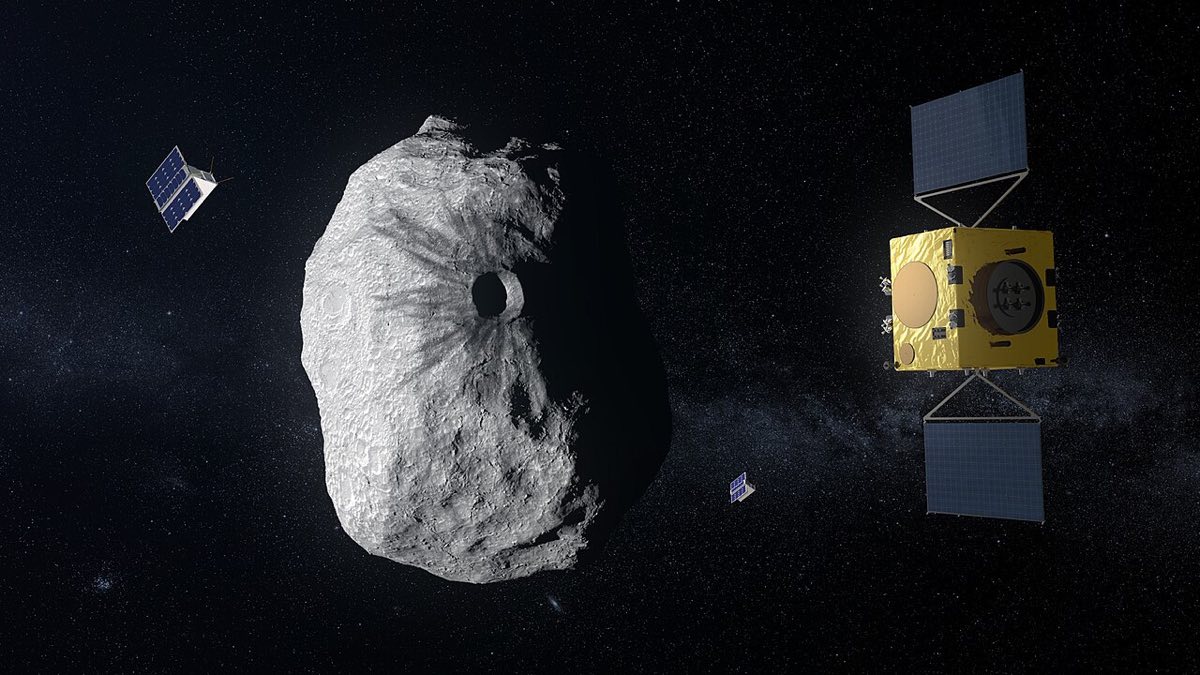
The European probe Hera has sent the first close-up images of the asteroid Dimorphos, which a NASA spacecraft deliberately struck in 2022. One side of the rock has been flattened by a stadium-sized crater, and the asteroid is now tumbling chaotically. Six researchers from the University of Alicante are on the mission team.
In September 2022 NASA’s 576 kg DART spacecraft hit the small asteroid Dimorphos, a moon of the larger Didymos, at 6.1 km/s. It was history’s first planetary defence experiment: can a dangerous rock be nudged off course? It worked even better than calculated — Dimorphos’s orbital period shortened by about 33 minutes. But what had happened to the asteroid itself could not be seen from Earth.
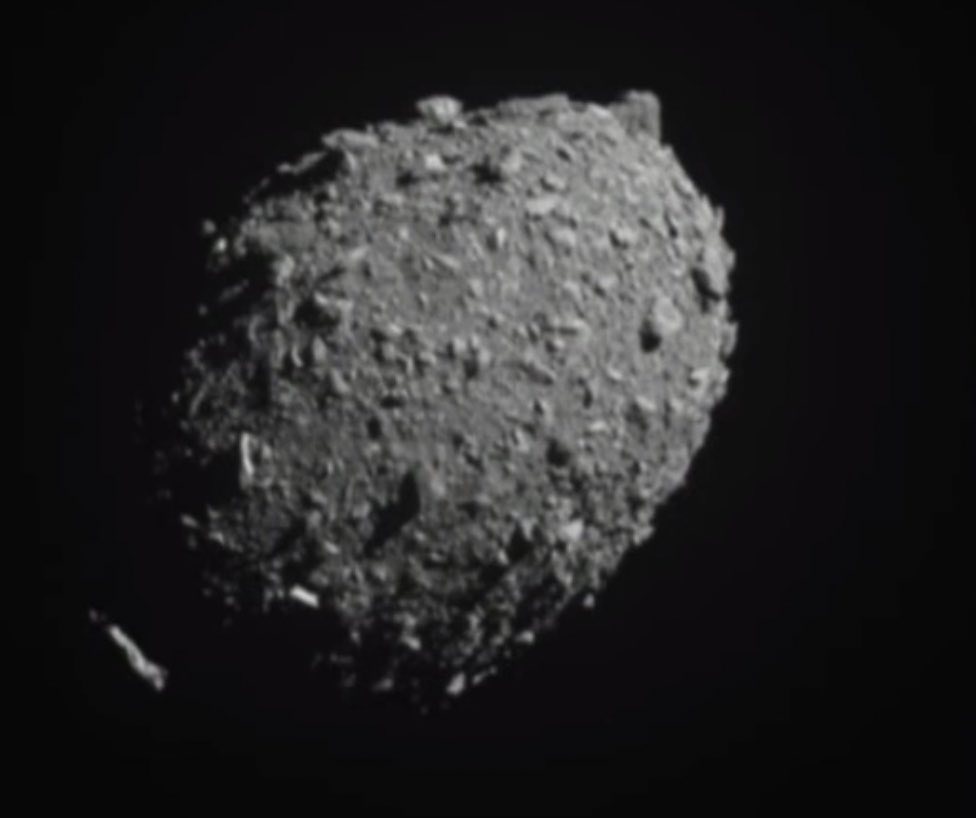
Now it can be seen. The European Space Agency’s Hera probe reached the asteroid pair in early November after a two-year journey and is photographing them from 25–30 km away. In the first images, at 2.7 m per pixel, the side that took the hit has been flattened by a crater stretching across the full width of the 151-metre asteroid; the rest of the surface looks as it did in 2022. ESA reports that Dimorphos has been left tumbling chaotically, and hundreds of previously unknown boulders circle the pair. The images were unveiled on 25 November at the Natural History Museum in Berlin.
📍 Where Alicante comes in
The University of Alicante’s planetary sciences group in San Vicente del Raspeig has been on the mission from the start: professor Adriano Campo Bagatin is in Hera’s coordinating team and attended the Berlin presentation, alongside Paula Benavidez, Laura M. Parro, Manuel Pérez, Po-Yen Liu and Tzu-Heng Chang. The group studies the internal structure and landforms of both asteroids and what became of the material thrown out by the impact. According to Campo Bagatin, these images are just the start of the scientific work, which will be a giant step for protecting Earth from asteroids. In December Hera will close in to 13 km, and in January 2027 it will release two shoebox-sized satellites: Juventas will use radar to look inside an asteroid for the first time, and Milani will study its material and dust.
Original source: Universidad de Alicante / ESA ↗